



The Power of Stereotypes on the Internet: Why Viral Memes About Beauty and Crime Are Misleading
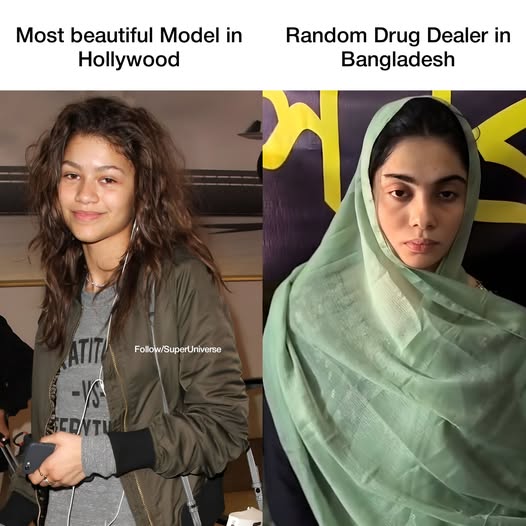
In the age of social media, images travel across the internet at incredible speed. Memes, comparisons, and viral posts often shape how people think about beauty, culture, and even morality. One recent type of meme shows a side-by-side comparison: on one side, a young Hollywood celebrity labeled as the “Most Beautiful Model in Hollywood,” and on the other, a woman labeled as a “Random Drug Dealer in Bangladesh.” At first glance, the post may seem humorous or shocking. However, when we look deeper, it reveals something more important about how stereotypes spread online and how easily images can mislead audiences.
The Problem with Visual Comparisons
Side-by-side comparisons are powerful because they simplify complex ideas into a single visual message. Our brains naturally try to interpret what we see quickly, and memes take advantage of this. When two images are placed next to each other with bold captions, viewers often accept the message without questioning its accuracy.
In reality, images rarely tell the full story. The woman in the second image may not be who the caption claims she is. The label “drug dealer” could be completely fabricated, taken out of context, or based on misinformation. The internet has countless examples where ordinary photos of people are reused with false captions to create viral content.
This practice can harm real individuals by spreading rumors or attaching criminal labels to someone who may have nothing to do with the accusation.
Beauty Is Not Defined by Geography
Another issue with this kind of meme is the suggestion that beauty is surprising or unusual in certain parts of the world. The comparison implies that beauty belongs mainly to celebrities or Western media figures, while a woman from a different country appearing beautiful is somehow unexpected.
This assumption reflects a long-standing bias shaped by global media. Hollywood and international fashion industries have historically promoted narrow standards of beauty. These standards often prioritize specific facial features, skin tones, and body types. As a result, people may unconsciously believe that beauty primarily exists within those media circles.
In reality, beauty exists everywhere. Every culture and country has its own aesthetics, traditions, and standards of attractiveness. When the internet portrays beauty as something rare outside Western celebrity culture, it reinforces outdated stereotypes rather than celebrating global diversity.
The Role of Memes in Spreading Misinformation
Memes are designed for quick entertainment, but they can easily become vehicles for misinformation. Because memes are short and visual, they rarely provide sources or explanations. When people share them, they usually focus on humor or shock value rather than verifying whether the claim is true.
The problem becomes even larger when the meme involves accusations of crime. Labeling someone as a criminal without evidence can damage reputations and spread harmful narratives about communities or countries.
In some cases, images used in memes are actually taken from unrelated contexts such as social media profiles, television appearances, or public events. Once the image becomes part of a viral meme, it can circulate for years with the same misleading caption.
The Human Impact Behind Viral Posts
It is easy to forget that every photograph online represents a real person. When images are repurposed into memes with false narratives, the person in the photo may experience embarrassment, harassment, or reputational harm.
Imagine discovering that your photo is circulating across social media with a caption accusing you of illegal activity. Even if the claim is false, the damage can spread faster than corrections. Friends, family members, or strangers may believe the meme simply because it appears convincing.
This highlights the importance of responsible sharing online. Before reposting a viral image, it is worth asking simple questions: Where did the image come from? Is the caption verified? Could the claim harm someone unfairly?
Why Critical Thinking Matters Online
The internet has created an environment where anyone can publish and distribute content. While this openness has many benefits, it also means misinformation can spread quickly. Developing critical thinking skills is one of the most important tools for navigating online content.
When encountering viral comparisons or sensational captions, viewers should pause and question the message. Searching for the original source of the image or reading credible news coverage can often reveal whether the claim is accurate.
Critical thinking also helps people recognize when a meme is playing on stereotypes or cultural assumptions rather than facts.
Celebrating Diversity Instead of Mockery
Rather than using images to create shock or ridicule, online communities have an opportunity to celebrate diversity. The world is full of people with different cultures, styles, and forms of beauty. Highlighting this diversity in a positive way can build understanding rather than division.
Social media can be a powerful tool for sharing stories, connecting cultures, and challenging outdated stereotypes. When users choose to share content responsibly, they help create a healthier online environment.
Conclusion
Viral memes may seem harmless at first glance, but they often carry deeper implications. Comparisons that mix beauty with accusations of crime can reinforce stereotypes, spread misinformation, and harm real people. By approaching online content with curiosity and critical thinking, internet users can avoid contributing to these problems.
The next time a shocking or humorous comparison appears on your social media feed, take a moment to question it. Behind every image is a person and a story that deserves to be understood rather than misrepresented.
In a digital world where information spreads instantly, responsible sharing and thoughtful discussion are more important than ever.